Archive for July, 2008

The History of the Nerli Family: Elaine M. Teixeira Reports

Monday, July 28th, 2008

Elaine M. Teixeira recently spoke with Frank Nerli, who resides in Redwood City with his wife, Millie, a native of Massachusetts. Frank is the last surviving immediate member of his family.

The History of the Nerli Family

by Elaine M. Teixeira


Paolo (Paul) Nerli arrived on the coastside in 1889 and joined his brother, Guiglielmo (William) who was farming  the “Martini Ranch”, in Montara.  He later sent for his bride, Isola Piegaia,  He then began farming in Lobitos and the couple resided on the property. 

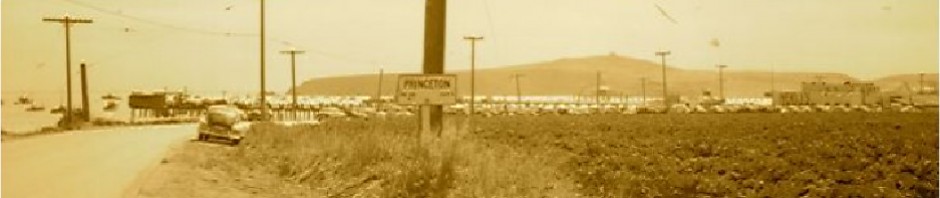
In 1925, they relocated to a farm across from the present airport property, near the northern entrance to Princeton; the house no longer is standing and the land is now farmed by David Lea.  Their family consisted of four sons and two daughters:  Ida, her first marriage was to a member of the Romani family, Gino, who married Norma Rossi, from Moss Beach, Pia, who married Roy Torre of Moss Beach, Frank , his first wife was Lena Gianelli, of Half Moon Bay, George and Edward, who married Barbara Valladao.  In the 1930’s the Nerli son. George, who was operating a fishing boat out of Monterey, was lost at sea; no evidence of what occurred to him or the boat was ever found.  His name is listed on a plaque in Princeton, which honors those lost at sea, from the local fishing industry.

In 1928, the family moved to Moss Beach, where Paolo bought property on Vermont Ave., near  the current location of Hwy One,  across from the Moss Beach Club.  On part of the property stood a barn which had been used by the Ocean Shore Railroad. When the railroad was in operation, there was a side track that came to the barn from the nearby main track.  The train would pick up produce brought to the barn by local farmers for shipment to San Francisco.  Paolo tore down the barn, except for one wall, which was left standing to assist in the building of a blacksmith shop.  The remaining lumber he used to build a home on the property.  His daughter, Pia, and her husband, Roy Torre, later built a home on Vermont, adjacent to the Nerli property. Later, Isola’s brother, Guiglielmo and Ida Piegaia resided in the  home and, after,  Albert and Pat Bertolucci.

In 1938, the Nerli’s decided to operate a business in Princeton in a small structure on Petroni property, across the road from a seafood stand  which was operated in the 1930’s by the Bettencourt family and later became Hazel’s Sea Food; today, it is the location of Barbara’s Fish Trap.  The building had a bar and Paolo added to the structure, a kitchen and dining room. Paolo, his wife and two younger sons lived upstairs.  They hired a cook and started up their business operation, serving Italian dinners.  Eventually, their daughter, Pia, worked as a waitress in the business, along with several other coastside women, and their son, Frank, was the bartender.  The oldest son, Gino, served as a replacement bartender on weekends.  They operated the business until 1958. Paolo and his wife sold the business, trading it for a home across the bay, where they resided for a year or two. 
They later returned to the coastside to live out their remaining years; both died during the 1960’s. Later the restaurant site remained closed for several years and was finally torn down and the area served as a parking area.  Today, it is the site of the Pillar Point Inn.

————————

Brother Buzz: “All Kinds of Whales Outside the Harbor.”

Monday, July 28th, 2008

Buzz is up and running great again!

Photo: A whale’s tail

Photos: On board Fran “Brother Buzz” Young’s boat

At Mavericks: Molly’s Forever Chasing Bubbles

Friday, July 25th, 2008

Rowena from Mountain View takes Molly to Mavericks where she practices chasing bubbles, getting ready to compete in that difficult category at the Olympics.

The “Irene”: Lorraine Piegaia Writes….

Thursday, July 24th, 2008

(The Irene, aka ‘the Emerald of Half Moon Bay’ is being returned to her former glory by Leland and Cecily Parsons at Pillar Point Harbor (619) 507-5071; they live in a boat moored at the harbor while restoring the boat. They are spearheading The Pillar Point Educational Fund, Inc. and efforts to re-launch the Irene.)

June, I have your book ”   Half Moon Bay Memories; The Coastsides’ Colorful Past ” ; I bought it in a book store in HMB in 1985.  I lived in Moss Beach, Montara, Half Moon Bay and El Granada from age 13 to about  33; but, my current husband, George Piegaia and 4 of our 6 ( now grown ) children were all born there on the Coastside.  I just love the book and the beautiful old fotos.  I was at my niece-in-laws home recently, she is also a niece-in-law to Elaine Teixeira; Elaine and I E-mail . I saw your newest book about Princeton at Betty Teixeira Tomberlin’s; but, didn’t have a chance to read it, nor get to the store to buy it yet.

Did you know about the on-going saga of the salvage of a very old family fishing boat, ” The Irene Bettencourt ” was to be dismanteled about 1 1/2 years ago; when a group formed, salvaged it; and, are now in the process of restoring and reburbishing her.  The boat  is up in dry dock on the pier in Princeton; and was the family fishing boat for three generations of Bettencourts; first owned ( possibly built ) by my two sons, Eddy and Steve Bettencourts’  Great-grandfather, Joseph Silva Bettencourt.  I believe the last son to fish in it is George Bettencourt Sr., deceased husband of Caroline; and father to George Jr. living in HMB. Do you know of this family and their story ?  Sincerely, Lorraine Nielson-Tomberlin-Bettencourt Piegaia.

Want to build a wooden boat?

Wednesday, July 23rd, 2008

Mermaids are hot around here

Monday, July 21st, 2008

Virtual Pillar Point

Sunday, July 20th, 2008

From John Vonderlin

Email John (benloudman@sbcglobal.net)

To enjoy panorama of Pillar Point, click here

Meet the Pink Abalone

Saturday, July 12th, 2008

A Pink Abalone!

Distinguishing Characers: Shell thick, circular and highly arched. Surface roughened with wavy corrugations (hence the name corrugata). Two to four large open holes bordered by sharply elevated rims, which may be worn flush with shell in some individuals. Edge of shell is usually sharply scalloped.

Exterior of shell dull green to reddish brown, surface usually covered by heavy vegetation and other marine growth.

Interior brillantly iridescent, nacreous portion predominantly pink with traces of green. Large muscle scar with prominent dark green markings. Grows to 10 inches in diametere but most are six to seven. Young specimens are quite flat until they reach three to four inches when shell begins to arch.

This species offers a variety of shell forms making identification by shell characteristics alone sometimes difficult. The epipodium extending below the edge of the shell is roughened, its upper edge delicately lacelike in structure, is mottled black and white. The long, slender, black tentacles extend beyond the edge of the shell and the body is blackish.

Distribution: Pt. Conception south to Turtle Bay, Baja Califoria. They are abundant on Santa Barbara and San Clemente Islands and have been found on all of the Channel Islands. Individuals of this species have been recovered from Cortez Bank and are also found at Guadalupe Island, Baja California.

Habitate: Along the rocky shores from the intertidal area out to 180 feet of water with major quantities located in the 20-to-80 foot depths. They are found in the more protected coves and bays as well as along the exposed coast in the active surf. They feed on giant kelp (Macrocystis) but will also eat other species of seaweed.

The young remain under rocks and in cracks and crevices until attaining a size of three and one-half to four inches. They then move out and take up residence on the exposed surfaces of the rocks and cliffsides of the ocean bottom. Tagging experiments indicate that there is little movement. Tagged abalones have been recovered in the same general area in which they were released as much as three years later.

From: California Abalones, Family Haliotidae (Dept of Fish and Game, 1962) by Keith W. Cox

Wanted: Mermaid

Friday, July 11th, 2008

Is this for real? How to Lasso A Crab

Friday, July 11th, 2008

Found on my doorstep

Salty Tips

By Steve ‘Hippo’ Lau

How To Lasso A Crab

Three decades or so ago I was chucking chunks of anchovy off of Baker Beach in hopes of catching a striper or two. After a few minutes of soaking my offering in the surf, I started to get some action on my rod tip. There was a distinct “tap-tap-tap” of something showing interest in my bait. Carefully, I plucked the rod out of the sand spike–waited a few anxious breaths–then set the hook.

NOTHING!

Reeling in my rig, I found the bottom hook of the two hook rig, stripped of its contents. How could something that bit so positively escape my lazer sharp hook and devastating hook set?

Rebaiting the bottom hook, I cast out again and decided that I wouldn’t set the hoook until whatever was harassing my bait swallowed it and put a definite bend in the rod.

With my rig back into the surf, I waited. A few minutes later, the tell tale signs of life came back to my rod tip. My mystery customer bit and bit and bit until its weight fully flexed the tip of my rod. I cranked down with the reel and kept reeling as the living weigh of whatever was on my line kept the rod bent.

As the wave receded, I finally got a good look at my quarry It was a big fat Dungeness crab! Surprisingly, it was not hooked, but in the midst of eating my bait, with the water swirling around him, my leader had tangled up around his many legs and claws when I dragged him in. I had, in effect, lassoed a crab!

Now, in the subsequent yers, I have not been able to duplicate this feat of having my leader lasso an unsuspecting Dungie, but someone has made it his practice to lasso crabs, and his name is Joe Eichensehr.

Joe is responsible for developing the first castable crab snare, and holds the patent on it to prove it. The crab snare is basically a ware cage measuring 4.5″ L x 2″W x 1.25″D with six loops dangling from it. Bait (Joe’s favorite is squid) is inserted into the cage, the cage is cast out, and a hungry crab comes running to eat its contents. When it is suspected that a crab is availing itself to your bait, a quick cranking of your

….more coming…