Archive for the ‘1946 Tidal Wave’ Category

Searching for photos of the 1946 tsunami leads to the unexpected..

Tuesday, January 15th, 2008

Back in the late 1970s, I self-published “Half Moon Bay Memories: The Coastside’s Colorful Past.” It was an exciting project, taking me places: physical, intellectual and emotional that I’d never explored before. My dream of emulating the Paris publishers of the 1920s had been fulfilled. I published a book that I loved.

“Memories” received a lot of publicity, including a big spread in the Sunday San Francisco Chronicle. As a result, I got letters from all over the country, letters that I’ve kept in a couple of shoe boxes. I realize now, having the Internet as an excellent resource, that I should have paid closer attention to some of the letter writers because they had good stories to tell me– but I didn’t follow up.

There were three letters from the Wiegels, postmarked San Francisco and Berkeley. J. Mason Wiegel, an attorney and editor of the Weekly Law Digest, headquartered on Montgomery Street, noted that as a child he had lived in El Granada in the house pictured on the bottom of page 142 of my book. His father had worked for the Ocean Shore Railroad, riding the train into the City every day. The Wiegels moved when the Ocean Shore filed bankruptcy.

In 1979 I also received a letter from R.I. Wiegel, a Berkeley resident. He was interested in buying the Memories book.

I didn’t connect the two Wiegels, J. Mason and R.L., until recently when I rummaged through the shoe boxes, opening and reading the 30-year-old letters, still crisp in their envelopes. A quick search of J. Mason Wiegel on the ‘net told me that he was gone–but copies of his Weekly Law Digest were available at a used book site. About R.I. Wiegel, I didn’t have a clue.

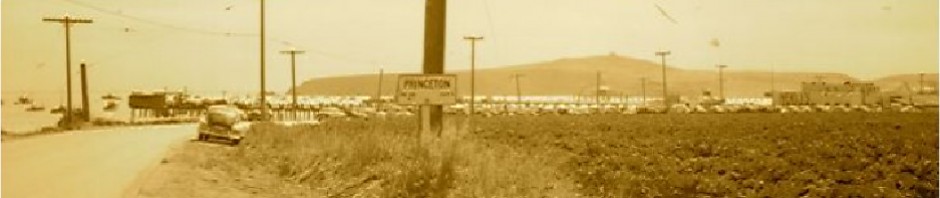
Meanwhile John Vonderlin, fascinated with the 1946 April Fool’s Day Tidal Wave, discovered that some photos of the tsunami’s damage at Princeton-by-the-Sea, might be found in the archives at UC Berkeley.

John was right. There were photos I hadn’t seen archived in the Water Resources Center, O’Brien Building, at Berkeley. The specific collection I wanted to see was kept in the R.L. Wiegel Collection. (There are some 50,000 images in the Wiegel Collection with about 16 of them relating to the 1946 tsunami.)

After the first of the year, 2008, Burt and I headed for the O’Brien Building, which we saw right away, is like going back in time. It is not a hi-tech venue. All around the old O’Brien Building, there are brand new structures going up, serving to emphasize the difference.

School wasn’t in full session so I didn’t have to wait long to see the slides in the R.L. Wiegel Collection. About 15 minutes later an elderly man walked into the room. He was clearly a man of authority and respect as the staff gathered around him.

One of the staff approached me and told me the man was Professor Robert Wiegel, would I like to meet him? Of course. Seconds later I was talked with the professor and had learned he was the man who had written me the letter in 1979. His brother was J. Mason Wiegel. Their father had worked for the Ocean Shore, completing the plans for El Granada and when the railroad ran out of money, Wiegel, Sr. was paid in building lots which he sold off slowly.

“My father said El Granada was the most beautiful place in the world,” Professor Wiegel told me.

I told him I had kept his correspondence; he said he still lived with his wife in the same house. Now in his 80’s, he didn’t come into the office much, so our encounter was special, indeed.

————————————
Here are the photos, all courtesy: Robert L. Wiegel Coastal Slide Collection, Water Resources Center Archives–University of California, Berkeley
1. Anderson, Howard (UCB Waves Project). About 10:30 a.m. Coast Guard pier and Romeo Fish Company. Tidal wave receding, highest level of water tried to lift boat in davits (at end of pier) and came to deck stringers. Highest tide reached 14.8 stage. (Robert L. Wiegel Coastal Slides Collection.)
2. Anderson, Howard (UCB Waves Project). April 2, 1946, tide at 3.7 stage, showing normal appearance of pier. Water came level with porch deck of Coast Guard shack at left. (Robert I. Wiegel Coastal Slides Collection.)
ps001553a.jpg

3, 4. Anderson, Howard (UCB Waves Project). Half Moon Bay 4-1-46. (About 10:30 a.m.) Miscellaneous pictures of tidal wave receding.(Robert L. Wiegel Coastal Slides Collection.)

ps001552a1.jpg

5. Anderson, Howard (UCB Waves Project) Half Moon Bay. About 10:30 a.m. Tidal wave receding, level of water is said to have come to the window sills of the house. Tide of 14.8 (Robert L. Wiegel Coastal Slides Collection.)

6. April 2, 1946. Tide at 3.7 stage. Same scene from end of pier. Coast Guard shack at right center. Beach was formerly fine sand; is now denuded, leaving hard clay base. (Robert L. Wiegel Coastal Slides Collection.)

ps001554a.jpg

April 1, 1946 Eastern Aleutian Is. Tsunami Damage…

Sunday, December 23rd, 2007

from NOAA click here

April 1, 1946 Eastern Aleutian Is. Tsunami Damage along the Alaska, British Columbia, Washington, Oregon, and California coasts

See References for information sources.

Location Amplitude (m) Damage Summary
Unga, AK 0.8 Dock and boats washed away.
Ikatan, AK ? Several homes washed away, Pankof light destroyed.
Sanak, AK 6.1 Boats beached, some houses destroyed.
Scotch Cap, Unimak I., AK 35 Five drowned. Lighthouse destroyed. Antenna 105 feet above sea level washed away. Radio station flooded.
Dutch Harbor, AK ? Ferrys carried away, docks damaged.
Nikolski, AK up to 12.2 Nine baraboras washed away
Taholah, WA 1.5 Five foot surge up Quinalt River swamped boats and damaged fishing nets.
Seaside, OR 1.2 Boats and log float swept away in Necanicum River.
Gold Beach, OR ? Sixty-foot float endangered. Slight damage at Winchuck River.
Noyo River Mouth, CA 1.4 Many boats broke from moorings, several near drownings.
Drakes Bay, CA 2.6 Crab pots rolled over, rowboat capsized.
Princeton, CA 2.6 Much damage. Houses flooded, quarter mile inundation, boats beached, dock damaged, $20K damage.
Santa Cruz, CA 1.5 One drowned. Minor damage.
Port Hueneme, CA 0.8 Sand swept over railroad tracks.
Santa Catalina I., CA ? Baseball field inundated, pier swept away.

…1946 Tidal Wave at Princeton….

Sunday, December 23rd, 2007

Thank you John Vonderlin for sending this…(email John: benloudman@sbcglobal.net)

From “United States Tsunamis”

1946, April 1, 12:29. A magnitude 7.8 earthquake in the Aleutian Islands generated a 30-m tsunami on Unimak Island that destroyed Scotch Cap Lighthouse. In California the tsunami caused a rise above normal tides of, 2.6 m at Half Moon Bay, 2.6 m at Bolinas, 2.4 m at Arena Cove, 1.5 m at Morro Bay, 1.5 m at Santa Cruz, 1.4 m at Noyo, 1.3 m at San Luis Obispo, and 1.2-m rise at Avila.

The Santa Cruz Sentinel reports confirm the unusual heights at Santa Cruz, and at Half Moon Bay, California. At Charleston, Oregon, near Coos Bay, 3 meter waves were observed, and 1.8 m. waves were observed at Clatsop Spit, Oregon, at the mouth of the Columbia River. The wave was 1.5 m at Newport and 1.0 m (range) at Siuslaw River. Other localities reported runups of less than 1.0 m.

At Noyo River, California, 100 fishing boats were thrown 1.8 m up bank. At Half Moon Bay where $1,000 in damage occurred waves swept into the unoccupied Coast Guard barracks loosening the building from its foundation. A house was flooded to the window sills. At nearby Princeton huge boulders weighing up to 70 kilograms were washed as far as high highway and some residences were flooded. Water was about 1 m deep on the road. A shack had a wall cave in, and it was moved 0.6 m from its foundation.

Also, at nearby Granada a 10 m boat was washed onto the highway….”

1946: April Fool’s Tidal Wave: Coast Keeps Midnight Watch on High Tide

Sunday, December 23rd, 2007

Tuesday, April 2, 1946

From the San Mateo Times:

“Princeton. April 2–Coastside residents today were taking the cycle of total waves in stride. Consensus of opinion was that there was nothing they could do about it, individually or collectively. After reading newspaper accounts and hearing radio reports of what happened in the Hawaiian Islands and elsewhere, local residents took the viewpoint that they were lucky with no lives lost and comparatively small property loss.

“Fearful that a high tide at midnight last night might result in more damage, a number of persons gathered at the Nerli restaurant to keep a midnight watch on the tide. Shortly after midnight, the restaurant closed and all departed.

“Several telephone calls were received at the coast guard station asking if a special watch were being kept and if a warning could be issued. Advised that Twelfth naval district orders had put the coast guard complement on the alert over night the persons, thus assured, apparently went to bed.

(more…)