Archive for May, 2008

Do You Believe in Rumors? Who Were the Elegant Hippies seen at the Oceano Hotel?

Thursday, May 29th, 2008

Friends have told me that they spotted some very rich, beautiful looking “hippies” staying at the Oceano Hotel in Princeton-by-the-Sea.

I got excited and asked: What does a rich hippie look like? What were they wearing? What did their hair look like? How many of them were there? What are they doing in Princeton? Making a movie?

The friends smiled broadly as I bombarded them with questions, ending with a harsh reprimand: “Didn’t you talk to them? I would have been ‘right there,’” meaning, I couldn’t pass them by without getting the answer to the most important question: “WHO ARE YOU?”

But my friends are not in the business of asking rich hippies who they are, and what they might be doing in Princeton; instead my friends just looked and admired and loved looking and admiring these seemingly out-of-place people wearing perfectly made counter-culture clothes and beads from the 1960s.

Now I hear that they were from a production company, involved with making a tv commercial for the “Hummer.” Hummers in Princeton?

1970s : Giant Log Was Carved at Miramar Beach

Sunday, May 25th, 2008

(Image: The Michael Powers homestead in Miramar Beach, with the huge redwood log in front. Photo by Michael Powers.)

In the late 1970s, Princeton shipbuilder Manuel Senteio, arrived at Miramar Beach, driving his crane to move a 20-foot-long, 3000 pound redwood log to photographer/sculptor Michael Power’s healing center, then in development.

The log had washed up on the nearby beach, and when Senteio saw how huge it was, and what his crane would have to lift, he exclaimed: “It’s big!”

Yes, it was VERY BIG AND VERY HEAVY–heavier still, from the sea water that had soaked into its pores.

Could Senteio’s crane lift the thing? To fulfill Powers’ plan, which was to carve the log, it had to stand upright. Could this be accomplished? Nobody knew for certain.

If all else failed, a crowd of Powers’ artist friends were on hand to help “psychically” raise the mammoth totem pole; its destination the peaceful inner garden. Half Moon Bay City Manager Fred Mortensen, a neighbor of Michael Powers, was there to lend more practical expertise.

There were many oohs and ahhs and oh no’s. This was the most dramatic event to occur in Miramar Beach for many moons.

But the crane lifter, Manuel Senteio was a professional: Can you hear the great burst of applause and laughter when the redwood log found its final resting place?

“Within this tremendous mass of redwood brought here to Miramar Beach by the sea,” said Michael Powers, “I intend to carve the forms of a man, a woman, and a child, a trilogy. It will probably take a year to complete but hopefully it will become a source of beauty and inspiration for everyone who comes to see it.”

Meet the Threaded Abalone

Wednesday, May 21st, 2008

Distinguishing Characters: Shell oval, moderately thin, arched. Attains a length of six inches but most are small than four. Surface fairly regular with prominent, broad spiral ribs interspaced by several low, narrow ribs or ridges.

Four to six holes open, small, tubular, raised. Shallow groove between holes and edge of shell. Spire moderately high. Surface of shell primarily greenish with patches and spots of dull brown, white, red or yellow. Outer lip of shell extends over inner nacreous surface, producing typical narrow reddish-brown and greenish colored border.

Interior surface iridescent, light pearly white. No muscle sear in most individuals, occasional sear-like impression. In larger specimens, some with small clumps of greenish nacre in vicinity of muscle attachment.

Body yellowish cream with brown blotching, epipodium light brown and cream, banded. Numerous small rounded protuberances on surface of epipodium, upper edge fringe-like and flecked with white. Orange tinted on edge of foot and mantle, eye stalks and in throat region. Tentacles short and light brownish-yellow in color.

Distribution From Pt. Conception south to Turtle Bay, Baja California, primarily along the mainland.

Habitat Rocky bottoms offshore in depths ranging from 10 feet (rare) to over 120 feet; greatest numbers are found in 70-100 foot depths.

From California Abalones, Family Haliotidae, Department of Fish and Game
By Keith W. Cox

Me with Ab

Wednesday, May 21st, 2008

Princeton-by-the-Sea is a place where many historic events happened

Wednesday, May 21st, 2008

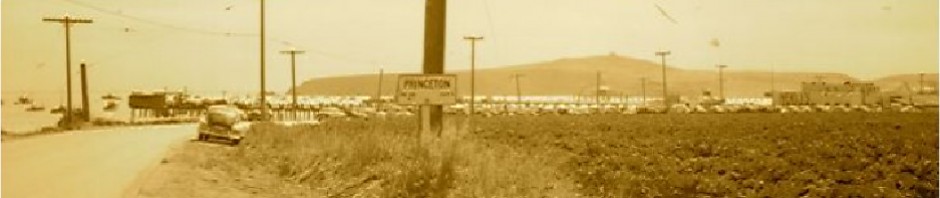
There are many of us on the Coastside who wish to see Princeton continue to be a “place,” with it’s name on an official sign, as in the classic photo at the top of my blog. “Princeton,” the sign reads, “pop. 200.” That population number hasn’t changed much, closely matching the number of permanent residents there today.

There are many of us who wish to see Princeton-by-the-Sea retain its unique identity, not to be lost in suburban sameness. Not to be consumed by the big, hungry town to the south.

Yes, I am a romantic, but not the only romantic, and Princeton’s economy thrives on romance in every tone, shade and color.

What happened to the old Princeton sign?

The Emerald of Half Moon Bay: Story by Bill Claudino

Monday, May 19th, 2008

Restoring the “Irene”: Emerald of the Bay

by Bill Claudino

Have you seen “the restoration project” at the pier in Princeton? The old fishing boat, the “Irene” is being restored. When I was a boy, this was the “Emerald of the bay.” In those days there was no “Johnson Pier”. The breakwater jetty had not even been constructed.

The “Irene”–a double-ender–wasn’t the largest boat in the harbor but it was the most envied. In recent years the “Irene” had fallen into almost total disrepair. A gent named Leland, who was sailing around the world on his 60-foot sloop (poor devil,) took pity on the old “Emerald of the bay” and decided to restore the “Irene”. He’s formed a non- profit that accepts donations and is vigorously trying to restore this classic fishing vessel.

I was never a commercial fisherman but as a long time local, I did spend some time on the “Irene” with its owner George Bettencourt, now deceased. Some of my most treasured memories were spent with George on board the fishing boat named after his beloved wife.

My mom went to school with George and his brother Henry, who was best known as “Uncle Henry”. They were both such nice people; everybody loved George and Henry. Their sons, George, Jr. and Dave, still live on the Coastside.

On most days you can find Leland and his wife Cecily working on the “Irene” (in the parking lot near the sea wall in the harbor). I made a small donation and they told me that next time I visited I should wear my “grubbies” and have fun working on the project.

dscn0878.JPG Reads: Pillar Point Educational Fund, Inc. Help Restore The Fishing Vessel IRENE…All parties interested in restoring and transforming IRENE (a fishing vessel for 3 generations) into a Harbor Touring Vessel, the proceeds from which would go into an educational scholarship fund for the children and grandchildren of commercial fishing families from Pillar Point Harbor,

Please contact: Leland & Cecily Parsons
619-507-5071

dscn0882.JPG

The White Abalone

Saturday, May 17th, 2008

Haliotis sorenseni Bartsch 1940

Distinguishing Characteristics: Shell thin and light, oval, highly arched, reddish brown color exteriorly. Surface sculpture regular, with low spiral ribs, usually covered by lush marine growth, especially tube dwelling mollusks. The holes are highly elevated and between three and five are open.

The interior is a striking pearly white with iridescent tints mainly pink; the outer edge of the lip is quite thin with a narrow red border. The muscle scar is typically absent, but if present is poorly differentiated; in some larger individuals small blue-colored nacreous clumps are scattered over the interior.

The epipodium is roughened and is mottled yellowish green and beige color. Its edges are scalloped and lacelike with occasional edgings of orange. The long, thin, light green and yellowish tentacles extend beyond the edge of the shell. The portion of the mantle extending over the head region of the animal is edged in purple.

The body is typically yellow or orange colored and the meat is quite tender. Shell attains a length of ten inches, but most are five to eight. Individuals smaller than four inches are rare.

Distribution: Not found north of Pt. Conception, taken only occasionally along the mainland at Pt. Dume, Palos Verde and San Diego. Most abundant among the Channel Islands of Santa Catalina, Santa Cruz, Santa Barbara, San Clemente and Los Coronados; also reported from Turtle Bay and Cedros Island, Baja California.

Habitat: A deep water form found from 15 feet (rarely) to 150 (may extend to greater depths), with greatest concentration between 80 and 100 feet.

—-

From California Abalones, Family Haliotidae, Department of Fish & Game, 1962

By Keith W. Cox

1945: Slain Sea Lions Strew County Coastline

Tuesday, May 13th, 2008

Story from the Half Moon Bay Review

The year was 1945

“Professional fishermen on the Coastside have turned hunters and their accuracy is costing the county a headache.

“The anglers are ‘knocking off’ the seals and sea lions that have been crimping their living by stealing fish from their nets–even pilfering their catch while they are hauling in their nets.

“Some time ago, following appeals of the fishermen, the state legalized the shooting of the culprit seals and sea lions. The fishermen have been packing their trusty arms since–and likely are getting some help from lovers of the sport of hunting.

“The beaches between Miramar and Pillar Point reveal that the fishermen are also good hunters. Last week, 38 dead seals and sea lions were strewn on the beach.

“The county’s headache is in “getting rid” of the dead mammals. They weigh 450 pounds each and it costs the county nearly $10 to bury each one.

“Maurice Rothchild, sanitarian of the county health and welfare department, said that his department was appealing to the board of supervisors for funds to defray expenses incurred in burying the mammals. He said the department had already used up in excess of $500 and that no funds had been allocated for the work.”

Northern California Developer Henry Doelger Took A Long Look At The Coastside

Sunday, May 11th, 2008

Famous developer Henry Doelger had much to do with plans to transform Princeton-by-the-Sea, Moss Beach and Montara in the 1960s. You can find some HMB Review articles related to Doelger on this blog.

Here’s a piece I wrote about Henry Doelger in 1999.

By June Morrall

Westlake made Henry Doelger’s reputation as a master Northern California developer. He seemed unstoppable, but critics took sharp aim at his usually monotonous boxy houses, and when he set his sights on the pristine San Mateo County Coastside in the 1960s, a storm of opposition awaited him.

Henry Doelger was born in behind a downtown San Francisco bakery in 1896. His formal education ended in grammar school, and he often quipped that he’d “flunk a fifth grade arithmetic test,” but the spunky youth possessed enough entrepreneurial spirit to open a hot dog stand, squirreling away every nickel he earned.

His first investment opportunity appeared in 1922 when Doelger looked at San Francisco’s undeveloped Sunset District and purchased a scruffy lot for $1,100. Two months later, he sold it, doubling his money.

Emboldened by the transaction, and ignoring the advice of those who said he shouldn’t build houses on the windswept dunes. Doelger purchased another 14 building lots in the Sunset District.

He eventually built 28000 homes, transforming the sandy terrain into “neat blocks of stucco homes.”

During WWII, Doelger further perfected his system of building uniform mass-produced structures, erecting 3,000 housing units for defense workers in South San Francisco, and other parts of the Bay Area.

At the close of the war, once again against the advice of others, he purchased 350 acres of coast range land in the northwestern part of Daly City, formerly home to hog and cabbage farmers.

Over the next two decades, Doelger completed his huge planned community called “Westlake,” consisting of some 9,000 homes, 3,000 apartments, community centers and—within walking distance–a major shoping center and a soon-to-be-very-popular restaurant called “Joe’s.”

With prices starting at $11, 964, Doelger’s homes were affordable for first-time buyers with the help of post-war, low-interest, government-guaranteed loans.

A special feature of the subdivision homes was the use of redwood in construction, including the sub-flooring, exterior siding and many interior walls.

Doelger heralded the Westlake subdivision as a “great contribution to community advancement,” while others derisively dubbed it “the White Cliffs of Doelger.”

The Doelgers–Henry, his wife, Thelma and their two children–resided at Westlake in a sumptuous home featuring a 20-foot swimming pool in the living room. Sharing the living quarters were assorted pets, including a blind pigeon, two dogs, a rabbit, two monkeys and three cats.

Part of each year the Doelgers vacationed at their Sonoma ranch. For the annual trek north, Thelma packed the menagerie of animals into a truck. Accomplished in her own right, Thelma was an avid painter who once exhibited her portraits and still life at the de Young Museum in Golden Gate Park.

By the 1960s, Doelger knew the bayside was fast running out of flat land useable for large-scale subdivisions, the raw material he required for his signature developments.

Anticipating this day, he had purchased 8,000 acres on the Coastside, stretching from Montara to Half Moon Bay. In Doelger’s mind the Coastside’s open land was a perfect setting for what he called his “New Community on the San Mateo Coastside.”

The Coastside project consumed Doelger, and to devote more time to it, he decided to divest himself of the Westlake Shopping Center, reportedly selling it for about $10 million.

Local legend has it that Henry Doelger invited his good friend, the president of the Bank of America, to the top of Montara Mountain. As the powerful pair scanned the rugged coastline, Doelger pointed and boldly announced: “Here is my new city.”

Coastsiders reacted swiftly to Doelger’s proposal for 13 planned neighborhoods, each with its own school, and a subdivision scheduled for Princeton called the “Tahitian Village,” to be modeled after Mission Bay in San Diego.

Many new residents, environmentalists, had moved to the Coastside for its open space and beauty. Painfully aware of Doelger’s visually monotonous subdivisions, they feared what he had in mind for the Coastside.

At contentious meetings organized by the San Mateo County Planning Department, residents voiced their fears, peppering Doelger’s representatives with questions about subdivisions with houses that looked alike, high-rise apartments blocking ocean views, ridge-line development, and a lack of water for the massive project.

Doelger’s people did their best to assure residents that the project would not resemble Westlake, explaining that they were projecting a cross-section of consumers, adding that future market conditions would dictate the time span over which the homes and schools would be built.

The Coastside locals were unmoved and the meetings dragged on. Perhaps worn out by the opposition, Henry Doelger decided to “ease up” on his Coastside project., turning the 8,000 acres over to the Westinghouse Electric Corp., and developers Jim and Bill Deane, who had won acclaim for their large Lake Forest subdivision in Orange County.

As he sold his real estate interests, Doelger said he wanted to devote more time to cruising the Mediterranean about his 140-foot yacht, the “Westlake II.”

In 1978, while touring Italy, 82-year-old Henry Doelger, once one of Northern California’s biggest building contractors, passed away.

Meet the Pinto Abalone

Saturday, May 10th, 2008

First, what happened to the old Princeton sign? The one you see in the permanent blog photo above…it says Princeton, pop. 300. Who has that classic old sign? We should put it back where it belongs.

Here’s the Pinto Abalone:

PINTO ABALONE
Haliotis kamtschatkana Jonas 1845

Distinguishing Characters: This species exhibits considerable variation in shell form. In its northern range, which extends from Alaska south to Pt. Sur, California, it is characterized by a long, narrow, highly arched shell, having a rough, irregular surface. Larger individuals usually have a prominent spire. In its southern form, which extends from Pt. Sur to Pt. Conception, the shell is more oval in shape and not as highly arched; the surface is more regular and smooth and the spire is not as high.

In both forms, the shell is thin, colored a mottled greenish-brown with occasional white and blue scattered over the surface.Holes number from three to six,usually five, with raised edges, and in some specimens a shallow, grooved channel under the lines of holes parallel to the edge.

The interior is an iridescent pearly white, typically with no marked muscle scar although larger individuals may have small clumps of of greenish nacreous substance scattered inside the shell in the region of muscle attachment. Raised, lumpy areas of exterior are reflected by hollows and pit-like areas in the interior. Sizes range to six inches, but seldom exceed four. The epipodium is scalloped and lacelike along the upper edge and colored a mottled greenish-brown. The body is mottled tan and greenish brown; some with tinges of orange. The tentacles are green and slender, and the tips extend from under the edge of the shell when the animal is moving or feeding.

Distribution: Sitka, Alaska, to Pt.Conception, California. Formerly thought to extend to northern Japan via the Aleutian Island chain,but the Japanese form has been established as a subspecies.

Habitat: In the northern range in Alaska it is found in shallow water among the rocks at low tide. Further south it is found in deeper water, and in central California the greatest numbers are found in the 35 to 50 foot depths. Although not a common species it is not rare, and in some areas in deep water offshore may be found in large numbers.

In deeper water this abalone is found more or less in the open on top of the substrate, rather than in cracks and crevices and on the undersides or rocks. The shells are covered with the same marine growths that are found on the substrate,making them difficult to distinguish from the surroundings. Food consists principally of small algae growing on the subsurface rather than the larger seaweeds which are favored by most of the other species. It is this diet which apparently gives the varied colors to the shell.

From “California Abalones, Family Haliotidae,” by Kenneth W. Cox, Dept of Fish & Game, 1962